

War of Inventory
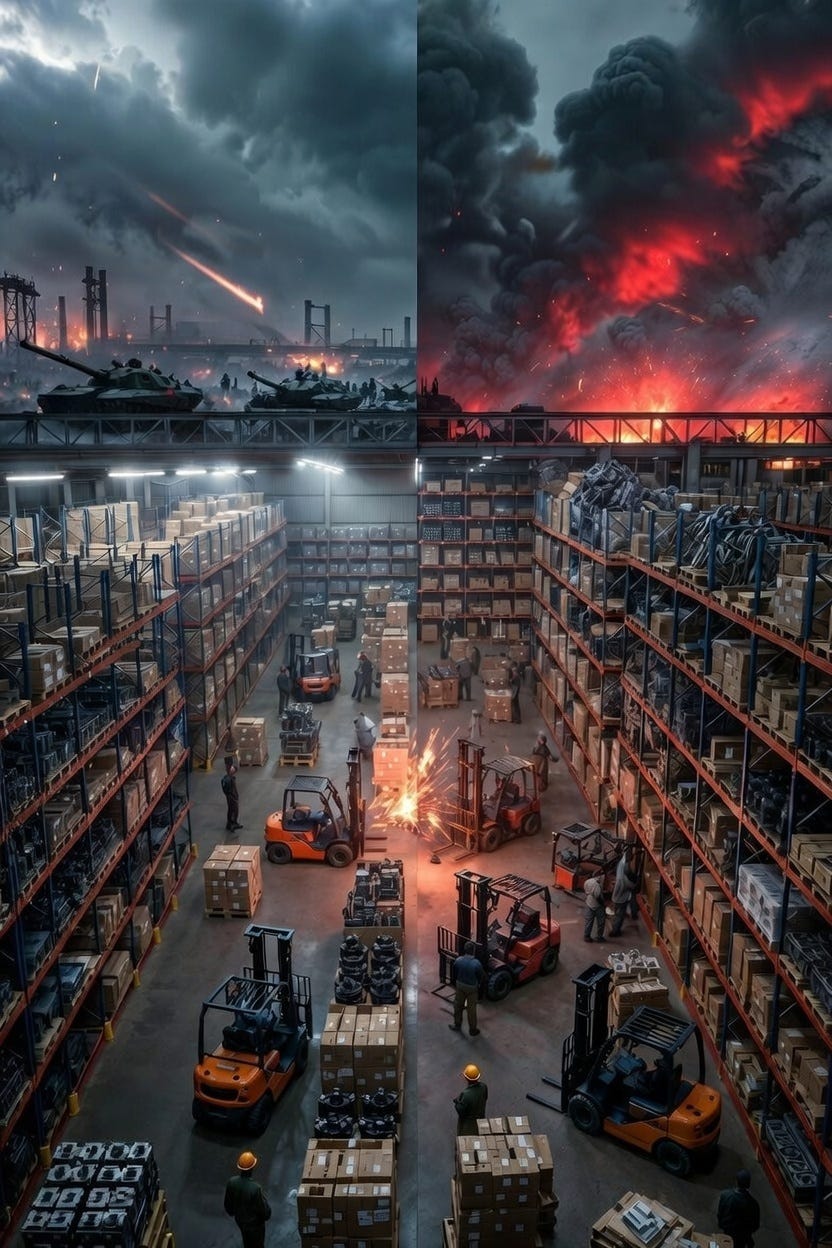
Future great-power conflict victory will more likely resemble World War I than World War II. It is entirely conceivable that within the first weeks of fighting, inventories on all sides are rapidly depleted, followed by a prolonged “phony war” while stocks are replenished. In such a scenario, victory does not hinge on battlefield brilliance alone, but on which side can replenish its inventory fastest and achieve sustainable cost dominance.
The war in Ukraine has already exposed a critical weakness: the U.S. defense industrial base cannot scale production quickly, even when operating in peacetime conditions. To future-proof American military dominance, the United States must focus not only on system performance, but on how those systems are manufactured. Systems need to be manufactured using mass manufacturing techniques vs methods economical for low/medium volume. Just as importantly, the Department of War must begin running manufacturing-scale military exercises to ensure industrial responsiveness in wartime.
We need to prepare for a war of inventory.
The Story of U.S. Manufacturing
The common narrative holds that globalization hollowed out U.S. manufacturing. Another camp argues that automation reduced jobs while increasing output. Both narratives are true — and both are incomplete.
A more accurate understanding emerges when we analyze manufacturing methods, not just industries.
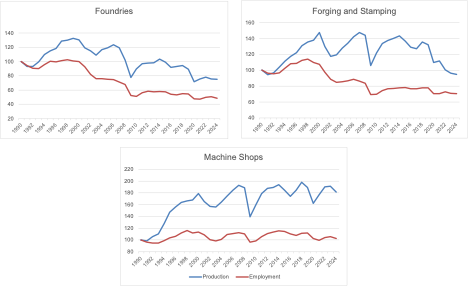
Source: FRED & Marlinspike research, 1990 = 100
As shown in the data, U.S. machining thrived: employment remained largely flat while output has increased by roughly 83%. Productivity gains translated directly into higher output without large job losses. By contrast, casting in foundries has suffered severely—employment is down approximately 52%, and output has fallen by 25%. Aggregate job losses reflect a combination of automation and outsourcing. Forging and stamping had mixed performance, moving from boom and bust cycles to structural decline.
Second-order effects of these trends help explain why the U.S. industrial base struggles to scale production quickly enough to supply Ukraine.
Exquisite Products and Flexible Manufacturing
U.S. weapon systems are exquisite, specialized, and produced in low to medium volumes. The optimal manufacturing approach for such products is flexible manufacturing, with machining as the archetypal example. Machining centers can be rapidly reprogrammed to produce different parts, keeping upfront costs low.
However, machining scales linearly, we need more machines to increase production volumes. At the same time with unit costs remain roughly constant regardless of volume.
By contrast, high volume mass manufacturing relies on tool-based methods, such as casting. These processes require significant upfront investment in tooling (molds), but once tools are in place, production rates are far higher and unit costs decline sharply as volume increases.
A simple rule of thumb applies:
· Low to medium volume → machining
· Medium to high volume → tool-based manufacturing
Exquisite weapons are inherently low-volume products. Accordingly, the U.S. defense industrial base has optimized machine utilization for peacetime demand, not wartime surge. Scaling production requires purchasing, installing, and commissioning new equipment—a process that can take a few years. It is entirely plausible that the war in Ukraine could end before new capacity comes online.
Defense contractors understand these lead times and respond rationally by limiting capital investment. The result is predictable: insufficient manufacturing scale in wartime.
Manufacturing philosophies
The aerospace sector largely explains U.S. dominance in machining. But as the saying goes, when you have a hammer, everything looks like a nail. Today, machining is widely used in US manufacturing. In 2000 US casting tonnage was approximately 15% higher. However, overtime Chinese output increased by a factor of 4x while US output decreased by 25%. According to Modern Castings, industry publication, by 2020 China’s castings output tonnage was 5.3x larger than US.
Our research points to a difference in manufacturing philosophies – China’s industrial base is geared for mass, US is for precision and flexibility. This leads to notable differences in how products are made – Chinese manufacturers would cast products to get them to wanted shapes, then machining would be performed to gain tolerances. In the US, product would be machined from the get-go. At lower manufacturing volumes – US firms are at a cost advantage, but if production scales, Chinese manufacturers will be at a significant cost and volume advantage.
As things stand today, China would win war of inventory.
Path Forward: Designing for Scale
Military-specific components should be designed from the outset for tool-based manufacturing, and as part of procurement process DoW should finance tools needed to manufacture products. While this approach would increase upfront costs, the payoff is resilience: production lines that can scale rapidly and sustain long conflicts at acceptable economic costs.
Tool-based systems also enable deeper integration with commercial industry. The Department of War could pre-position tooling at commercial manufacturers, enabling rapid production scaling in a crisis. This would also allow the department to stress-test supply chains in advance.
Just as the military runs deployment and readiness exercises, DoW should conduct manufacturing-scale exercises—calling up suppliers, switching production lines, and measuring switchover times. Only then can we have confidence that the industrial base can be repurposed quickly enough for war.
Conclusion
At the beginning of 20th century, British trade journals made smug reference to American car manufacturers because of their focus on reducing manufacturing cost. However, American focus on production methods during product design led to rapid industrialization. English smugness led its car industry into irrelevance. But somewhere along the way we also lost the plot and we started making same remarks as English, but focused on Chinese manufacturers.
While DoW is changing the way it does business, focusing heavily on procedures and regulations; however, the effort will not deliver optimized results if manufacturing techniques of systems are not taken into account.
Just got done reading Troy Thompson’s article on the Southeast as a frontier tech corridor and it pulled me back to this one. You’re making the case that we need to shift from machining to tool based manufacturing and run surge exercises to prove we can scale. Troy is essentially mapping where you’d run them. $80B in annual DoW spend already flowing through seven southeastern states, sitting in what he calls the “resilient band” where you can add manufacturing missions without building company towns. The pre positioning concept you lay out here, placing tooling at commercial manufacturers for rapid activation, fits almost perfectly onto the corridor he’s describing. Feels like two halves of the same argument. https://innoblepursuit.substack.com/p/frontier-tech-corridor-southeast
I really like the exercises idea. I am surprised no one has pushed the manufacturing exercises idea further but they should.
I have been writing about the political and cultural side of this problem. Hope you can give it a look
https://lukechen.substack.com/p/abundance-for-defense