

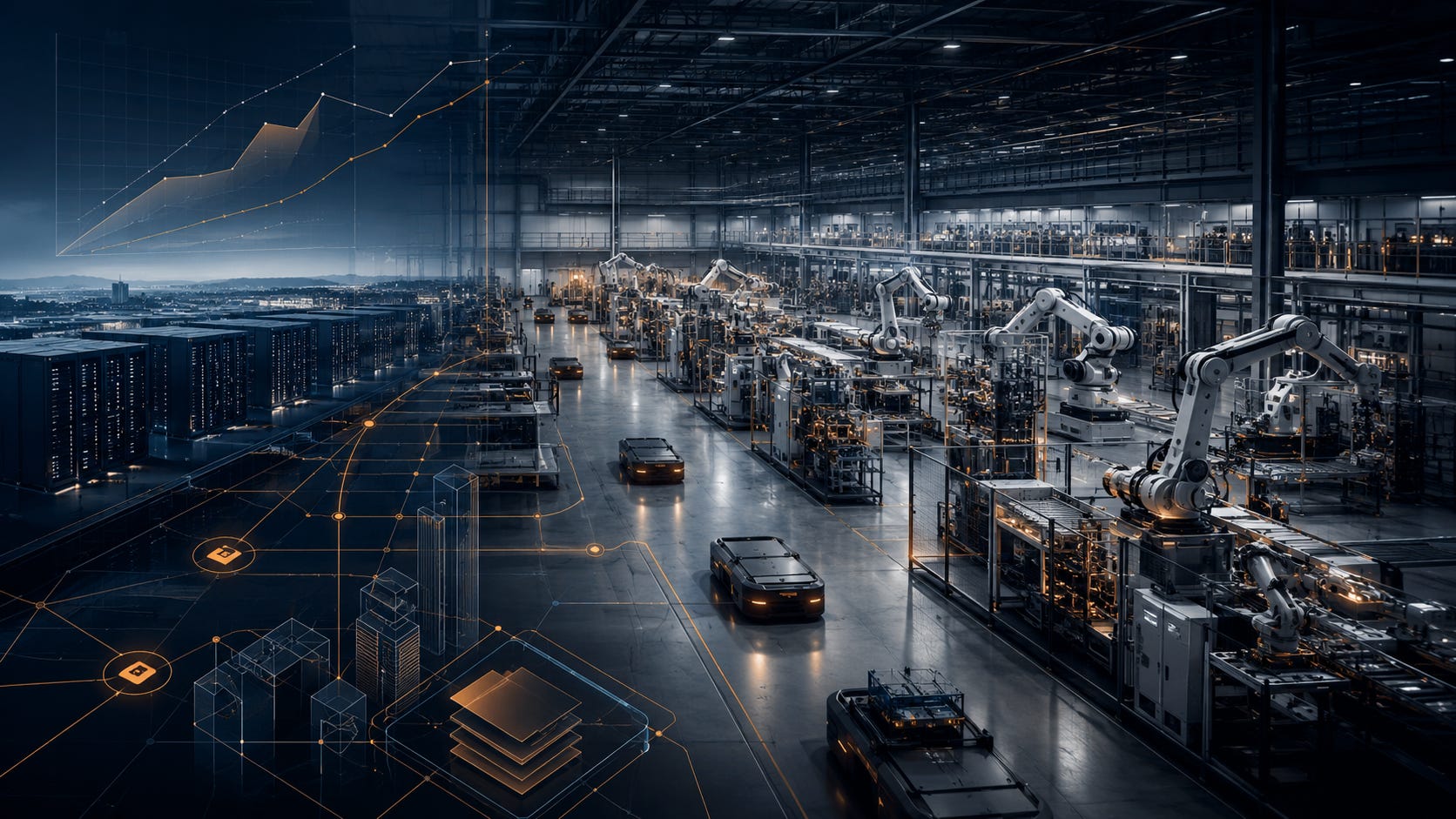
Every major technology platform eventually creates an infrastructure layer. The internet created fiber and data centers. Mobile created spectrum, towers, and edge networks. AI is creating a new generation of power, compute, and data center infrastructure. The same pattern will repeat in the physical world.
Robotics will not remain just another hardware category. It will split into two businesses: product companies that design and operate autonomous systems, and infrastructure companies that own and finance robotic capacity.
That may sound early. It is. But the market is starting to show the same signs that preceded prior infrastructure categories: constrained capacity, high upfront capital intensity, recurring demand, operational complexity, and customer preference for buying outcomes instead of owning assets.
The core insight is simple: as the economy moves from human-centric workflows to autonomy-centric workflows, physical-world capacity becomes investable infrastructure. Robots will not just be sold. They will be deployed, financed, maintained, upgraded, and underwritten as productive assets. The companies that turn robotic capability into reliable, contracted throughput will own a critical layer of the physical economy.
From automation product to infrastructure platform
Most robotics companies are still framed as hardware startups. They build a machine, sell it to a customer, and hope the customer can integrate it. That model works in narrow cases, but it does not unlock the full market.
The reason is obvious: most manufacturers, logistics operators, construction companies, and field-service organizations do not want to become robotics integrators. They do not want to buy a robot, hire controls engineers, manage software, source spare parts, absorb downtime risk, and figure out upgrades.
Customers want output capacity, not integration risk. They want parts shipped and systems assembled.
That shift - from selling machines to selling capacity - is the foundation of robotics infrastructure. A robot by itself is equipment. A robotic manufacturing lines operating under a multi-year customer contract, with software, uptime data, maintenance history, service-level agreements, and recurring revenue, are infrastructure.
Why this matters now
The physical economy is becoming the bottleneck. AI can generate designs, but it cannot manufacture the parts. Defense demand can surge, but drones, vehicles, sensors, ships, and munitions still need to be built. Data centers can be financed, but land has to be prepared, steel erected, power systems installed, cooling connected, and facilities maintained.
The limiting factor is no longer information. It is execution.
This is the Marlinspike view: the next phase of technology will be defined by the movement from the digital economy into the physical economy. The world is moving from human-centric systems to autonomy-centric systems. That transition requires a new design-build-operate stack. Robotics sits at the center of the stack.
If we are serious about reindustrialization, defense production, energy resilience, and domestic manufacturing capacity, robotic factories cannot be treated as a narrow automation tool. They are becoming part of the nation’s strategic infrastructure. The United States does not have a shortage of software ambition. It has a shortage of scalable physical throughput.
The new business model: capacity-as-a-service
AI is changing how we design, build, and operate hardware. It accelerates product design, enables automated factories with minimal human involvement, and creates new business models for end products. The most important robotics companies will sit at the intersection of all three layers.
Products will be designed for robotic manufacturing. Factories will build those products while collecting process, quality, and throughput data. Deployed products will generate usage data that feeds back into the next design cycle. Each layer reinforces the others. The result is a self-improving loop that makes manufacturing faster, more flexible, and more financeable.
In a capacity-as-a-service model, customers enter into long-term production contracts with robotics companies. The robotics company builds the product inside its own facility using flexible robotic cells, software-defined production lines, and continuously improving automation systems. Customers avoid the upfront cost of building factories, the delays of standing up production, and the complexity of managing labor, equipment, maintenance, and process optimization.
Instead, they buy guaranteed capacity, faster iteration cycles, and lower execution risk. This is especially important for defense and industrial markets where demand can be strategic, urgent, and uneven. A government or prime contractor can provide long-term demand signals; the robotics company can turn those signals into financeable production capacity.
Cost of capital is strategy
The robotics industry has an obvious but under-discussed problem: too many companies will use the wrong capital to finance the wrong assets.
Venture equity is the right tool for technical risk. It should fund autonomy, perception, AI models, systems engineering, customer discovery, deployment learning, and product iteration. Venture equity is expensive because it is supposed to take uncertain risk.
But once a robotic factory is deployed into a repeatable use case with contracted revenue, the question changes. The company is no longer only funding invention. It is funding an asset base. That asset base should not be permanently financed with venture equity.
For hardware companies, cost of capital is strategy. Every unit shipped, deployed, leased, or operated consumes capital. Every customer win can create inventory, installation, spare parts, service, maintenance reserves, and working-capital demands. Growth can drain cash if the balance sheet is not designed correctly.
The basic rule should be: own uncertainty, spin out repeatability. The venture-backed parent should own software, autonomy, fleet management, deployment playbooks, customer relationships, data infrastructure, and the technical roadmap. Repeatable factories operating under long-term contracts can be sold into infrastructure vehicles once performance data is established.
How the structure scales
This structure separates technology risk from asset risk. Venture investors underwrite the upside of the robotics platform. Infrastructure investors underwrite contracted cash flows, utilization, uptime, maintenance reserves, customer credit, asset life, insurance, and redeployability.
It also lowers the blended cost of capital. The company does not need to issue expensive equity for every incremental robot, cell, or facility. Proceeds from asset sales to infrastructure vehicles can be recycled into new deployments. The robotics company can continue earning software, monitoring, support, maintenance, or licensing revenue while infrastructure capital owns the lower-growth physical asset.
This is not a day-one structure for every robotics startup. Early technical risk still belongs in the venture-backed parent. But once deployments become repeatable, founders should think hard about their balance sheet deployment strategy. A factory with stable contracted cash flows may be more valuable to an infrastructure fund than to a venture-backed balance sheet.
What must be true
A robotics company cannot simply declare itself infrastructure and expect lenders to show up. It must build the evidence base that allows capital providers to underwrite the asset.
That means multi-year customer contracts, minimum revenue commitments, clear cancellation penalties, strong service-level agreements, uptime data, predictable maintenance costs, insurance coverage, and proof that assets can be redeployed if a customer churns. Infrastructure capital will not fund vague autonomy narratives. It will fund specific asset pools with contracted revenue and measurable performance.
This is how new asset classes emerge: the technology works, customers adopt it, recurring revenue appears, asset performance data accumulates, debt enters, and infrastructure capital scales the category. Robotics is still early in that transition, but the direction is clear.
Strategic implication
A country that cannot build physical things at scale will lose strategic autonomy. It will depend on brittle supply chains, foreign manufacturing bases, and the goodwill of trading partners. Software alone cannot solve that problem.
Robotics infrastructure matters because it creates scalable domestic productive capacity. For defense, it can expand production of drones, vehicles, sensors, components, and munitions-adjacent systems. For energy, it can accelerate deployment of generation, storage, and grid infrastructure. For manufacturing, it can give hardware startups access to production capacity without forcing them to become factory owners.
This is why robotics should be viewed not only as an automation tool, but as a national industrial capacity layer.
The bottom line
The next generation of great robotics companies will not simply sell machines. They will build, operate, and finance manufacturing capacity. They will convert autonomy into throughput, throughput into contracts, and contracts into infrastructure-grade cash flows.
For investors, the implication is straightforward: robotics is not merely another venture category. It is the next infrastructure asset class for the autonomy-centric economy.
This article was edited by ChatGPT.